Interview with Empty Quarter’s Pam Minty and Alain LeTourneau

November 1, 2011 · Print This Article

Portland filmmakers, educators, programmers and film advocates Alain LeTourneau and Pam Minty are in the midst of a Midwest and east coast tour with their avant-doc Empty Quarter. The work is a decade in the making but even beyond that knowledge there is something very large feeling about it. Perhaps this weight is due to the scope of its subject: the three southeastern counties of Oregon (Lake, Harney and Malheur), its wide-ranging citizenry and their activities both quotidian and transformative. I imagine the openness with which a viewer can interact with the piece, though, has more to do with how large and multivalent it feels.

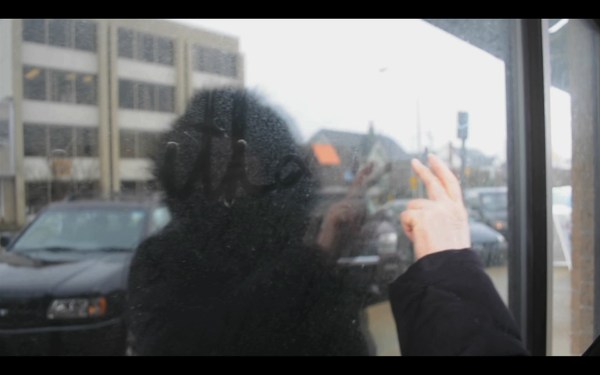
Empty Quarter is formally divergent from conventional documentaries in several obvious ways: its format—from camera to projector—is luminous black-and-white 16 millimeter film; the scenes are composed of lengthy, single shots for which the camera is fixed; the subjects—landscapes and the workers, families and machinery that people them—exist without a narrator’s context, without an onslaught of subtitular text; during those intervening interview portions where direct human voices are heard the screen is completely black (save for those occasional scratches or imperfections the film print will accrue as it makes its way through projectors across the country). It is, as such, in the tradition of other makers who take as their subject the real world. As a documentary, its polemic is apolitical (so far as parties are concerned), but deeply humanistic and with a strong feeling for the strange, beautiful landscape and the industries, families and outside communities with which they function.

Because the film is so open in its presentation, questions relating to urban and rural divides, race and ethnicity within agricultural sector and regions, land stewardship and labor are all invoked. While Pam and Alain were in Chicago screening the film (one hopes they’ll find time for us again on their spring tour of the film), we were able to speak at length about the decade long process of its making, the bold formal elements of the work and the nature of their collaboration.

It seems silly, but sometimes the easiest way to digest works that are formally inventive or distinct is to first think about those differences as an entry into the work. Empty Quarter is a documentary, but will never be described as such without a tag like experimental or essayistic or landscape or avant before it.

Alain LeTourneau: Empty Quarter attempts to create a cinematic experience closer to lived experience. That is, raw and undigested. The viewer would move through and make meaning of the spaces and activities presented. We wanted the relationship to the audience to remain open, allowing the audience to participate on some level. If we had presented a series of opinions or arguments, the viewer would be left in a position of agreeing or disagreeing with the information presented. As a portrait of a place, Empty Quarter is a series of recorded observations. The viewer can enter in to and inhabit the shots/scenes taking away a set of personal reactions, which can then be shared with other audience members, friends and perhaps family. The cinematic experience is intended to extend or ripple out into people’s lives, becoming part of public life.

One of the most striking (and I think best) choices you made in this film is the use of black during the interview segments. 

Pam Minty:  While all image-based shots are set to sync sound, audio interviews with residents from the area are set to black screen.  Our intention in this approach is to give the audience the space to listen in a focused way not competing with the function of visual observation. Many of the issues discussed were repeated across several interviews, so it seemed more appropriate to allow unmitigated sound to convey these shared experiences, opinions and concerns. To some extent, the use of long visual takes informed the choice to give equal or similar weight to collected audio recordings. There was a decision in post-production to mix sync voices more prominently in an attempt to replicate being in the environment and give the audience the opportunity to experience what grabbed our attention most.

Though it seems to hard to imagine this film functioning otherwise the use of black & white seems to work on a number of levels here. It does something to heighten the notion of the work as intentionally produced (as art, as artifice), which seems counter to so much of how most documentaries are made, but it also seems to reinforce the work’s place in a historical trajectory.

AL: 16mm black and white can blur the distinction between seasons, times of day, and tends to focus one’s attention on the activity or landscape being framed, without presenting itself as “reality”. The black and white images are presented as a document or observed record. The texture or grain is also quite wonderful, the way it creates shimmering, almost impressionistic images, unresolved and lower in quality than color.

The whole film is filled with beautiful, evocative images. But without giving too much away, I feel like the final shot (above) is so elegant, so well paced and so well constructed that both times I’ve seen the work someone from the audience has asked whether or not it was choreographed. In itself, it’s an interesting question because the question is not whether the drivers of the farm equipment were directed, but choreographed, but also seems a good jumping off point to ask about how much was done to “direct” the participants in the film.

AL: The final shot in Empty Quarter came out of our experience of observing various patterns that occur in the process or routine of work, whether manual or machine labor. The camera was positioned to present a kind of symmetry with movement in the image, and to unfold in a very subtle way.

PM: We’ve found that audiences have used those terms differently to respond to different images. When machines appear to be moving in a planned way, we’re asked about whether we choreographed the scene. Conversely, when people enter a shot, perform an activity, and (in general) leave the frame, people tend to use the term “direction” in how they phrase the question. Ironically, the most choreographed looking scene, the closing shot, was one in which we had the least ability to manipulate how the corn harvest activity unfolded. Alain’s intuition about when to begin filming in relation to how much film was in the magazine for the tilling of the last row of corn, was critical. Also, his choice to frame the shot as he did lent to the power of that shot. Had he centered the final row tilled, the trucks would not have been symmetrical as they left the frame left and right, and it wouldn’t have happened simultaneously. In a post-film Q&A, he’ll call it dumb luck, but as a witness to that moment, it really comes across as good decision making, being aware of the frame, and keen observation about how the process unfolds.

There’s always something inherently quixotic to the project of documentary. The idea of representing another’s lived experience is always an impossible challenge, but the idea of representing such a gigantic amount of space and the wide-ranging experiences of those who live and work there is even more vast. There are always those in the moving image world who argue for a utopian concept of total representation, of a 360-degree, interactive cinema, and compared to these, the thoughtfully-constructed, single-take scenes of a place seem to argue towards the specificity of your framing and the intent inherent to leaving so much out of the frame.

AL: Total or complete representation sounds like an impossible project. Additional funding would have allowed the film to be longer, maybe three hours, but whether the film would have benefited from this additional material is hard to say. I think we would have enjoyed the opportunity to continue recording and documenting the work, recreational activities and landscape of the area, but even given more material and longer run time, I think it would be difficult to say that we could provide an exhaustive view of the region. We certainly could have shined light on more of what happens in the area. For example, we had an offer to record inside a one-room schoolhouse in a remote part of Lake County, but the completion schedule and our budget would not allow us to incorporate this into the film.

There are a lot of political, social and ecological issues that are hinted at in the film. Compared to most films, or even to most conversations, the film feels balanced (not simply right-and-left, but front-and-behind, top-and-bottom). What lead you to give this film this seemingly non-political vantage?

AL: While Empty Quarter is not overtly political, I would not say it’s non-political or does not on some level engage political questions. The film certainly does not provide any kind of dramatic conflict that is eventually resolved or persuasive argument. In acknowledging our distance from the region and our urban detachment from rural lifestyles, our approach was more of simple observation, which seemed of greater value than a more traditional approach.  Looking at—and listening to—the region in an effort to provide a means of thinking about its place in the social and economic fabric of American culture­ was a critical aspect of our interest in the project.

The same people that have told me the idea behind making a film is to a tell a story also told me that film is the most collaborative of art forms. This concept is obviously based on a large studio system in which hundreds of people do their parts to manifest the vision of a director. The history of avant-garde film, however, takes a central (if sometimes only implicitly or out of necessity) interest in the single artist, the lone maker. Somewhere between these poles lies your own dynamic. Can you describe the process of working as a couple?  How do you conceive of our collaboration?

PM: Our earliest experience as collaborators in the production of Empty Quarter was simultaneous to beginning our work co-programming an experimental film series now operating under the name 40 Frames. In 2000, we moved into a warehouse space that could accommodate screenings as well as house our film production facility. As we wound down the production process and moved into post, we transitioned out of programming into the advocacy role we perform now with 16mm Directory, which is the primary activity of 40 Frames. We’re both working on independent films now as we distribute Empty Quarter. Once these projects are complete, we plan to collaborate on a second film on the subject of work.

Jesse Malmed is an artist and curator. He is brand new to Chicago and Bad at Sports. His work can be seen at www.jessemalmed.net.


Episode 303: Yael Bartana

June 20, 2011 · Print This Article


download

This week: Bad at Sports humbly presents Yael Bartana. We speak about her film work, identity struggles, the history of war and power, and just how an Israeli comes to represent Poland in the 2011 Venice Biennial.

Bio from Experimental Television Center

Yael Bartana was born in 1970 in Kfar-Yehozkel, Israel. She has a BFA from the Bezalel Academy of Art and Design in Jerusalem, an MFA from the New York School of Visual Arts and participated in the Rijksakademie artist-in-residence program from 2000-2001. She has had solo exhibitions in many countries including Germany, Israel, Australia and Japan and has won various prizes such as the Anselm Kiefer Prize (2003) and the Dorothea von Stetten-Kunstpreis (2005).

Her work focuses mainly on the relationship between ritual and identity in Israeli society, looking at the practices that constitute identity, especially in its relation with traditional and contemporary notions of gender, place and ethnicity. In most of the pieces Bartana uses documentary footage shot in public or semi-public spaces at collective events that contribute to identity formation, such as shooting drills for trainee female soldiers or the carnivalesque festivities of the Jewish holiday Purim. Bartana currently lives and works in Amsterdam and Tel Aviv.

www.my-i.com

http://www.experimentaltvcenter.org/history/people/bio.php3?id=40

http://www.labiennale.art.pl/


http://www.berlinbiennale.de/blog/en/7th-biennale/jrmip-congress-in-berlin


The Woodmans

February 14, 2011 · Print This Article

PhotobucketAt first, C. Scott Willis’ latest film “The Woodmans” appears to be a film documenting Francesca Woodman, who at the age of 22 took her own life and left behind a body of exquisite photographs. Instead, it is a rare portrait of an artist family, all of which have been successful, in their own right. This is not the first documentary on Francesca Woodman. In 2000 Elisabeth Subrin created the film, “The Fancy” in which she models a linear time line by “[reorganizing] information from the catalogues in order to pose questions about biographical form.” But unlike Subrin, Willis had an all access pass to Woodman’s diaries, photographs, some of which have never been exhibited, and her family – the three together trace the artist’s early life and death.

Growing up in an artist household – mother Betty a ceramist who has shown at the Met and father George, a painter who has exhibited work at the Guggenheim – both Francesca and her brother Charlie spent much of their time in and out of their parents studios. “Our children learned that art is a very high priority; you don’t mess around. They learned this is a very serious business at an early age,” George Woodman says as he sits near one of his paintings. The family spent time between Colorado and Italy with Francesca and Charlie switching back and forth between schools. As an act of defiance as a teenager, Francesca enrolled in the Abbot Academy, a boarding school in Massachusetts – her father gave her a camera to take with her.

Francesca quickly began photographing herself and her friends, often in the nude. Willis interviewed childhood friends who expressed their perplexity at the time. But, George and Betty were not phased by her daughter’s comfort in front of the camera; “I looked at Francesca’s photographs almost more as formally what they were rather than getting myself tied into knots over the subject matter. I don’t see them as autobiographical but I guess in some way all the work we make is autobiographical; it’s about us,” explains Betty.

Photobucket

Between the years 1975 – 1978 she created some of the iconic photos we know today while an undergraduate at the Rhode Island School of Design. After graduating she moved to New York where she briefly worked as a fashion photographer’s assistant. The use of her journal as a partial narrator gives an intimate look into her troubling final years. Towards the end of her life she struggled to create work and seemed dissatisfied with the lack of notoriety she was receiving.

Towards the end of the film we see the family continuing with their artistic practices. When asked how the loss of their daughter affected their work Betty says that they have each “dealt with it in different ways.” Although Betty took a break from creating work George shifted his practice to photography – creating unsettling images of young naked women that resemble his daughter’s work.

Willis is really able to build a great tension – the film can really make you feel uncomfortable at times. Preconceived notions of a privileged artist family can be hard to avoid. Although I feel as a director he strived to present his subjects in the best light they do not always come off that way. The inevitable jealousy of Francesca’s fame comes up several times in the film. Handling the estate themselves, the family has seen her work eclipse theirs. But candid statements of their frustration humanizes the family who come off a bit disconnected at times. While sitting near the family’s pool George expresses his concerns, “She was so good; she made my own work look kind of stupid…I wouldn’t mind getting a bigger slice of cake myself.”


As Deep Throat once said: Follow the Money

October 29, 2010 · Print This Article

Capitalism

Capitalism, 2009, 4 video loops, 1'19'' by Istvan Laszlo

Versailles art show hit by injunction bid
From the wet dreams of the marketing people behind Japanese pop artist Takashi Murakami’s show at Versailles a descendant of the man who built the Versailles Palace in France is seeking an injunction to prevent modern works by Japanese pop artist Takashi Murakami from being shown there. The legal battle is fronted by Sixte Henri de Bourbon-Parme in defence of “respecting the chateau and ancestors.” The ultra-conservative royalist has united with a group, the Versailles Defence Coordination, to file the suit, in which they stake a claim for the “right to access to heritage.” Read more here

Prince Charles offers to oversee London architectural planning
This week in “What could possibly go wrong?” Prince Charles offers to take on key architectural planning role in the vaccum created by the quasi-autonomous non-governmental organisation that had its funding axed in the comprehensive spending review. The offer, announced by the foundation’s chief executive, Hank Dittmar, has been met with dismay by leading modernist architects who fear Prince Charles may use the role to advance his own traditional tastes in design. Read more here

Studio Manager Anne McIlleron talks about her boss William Kentridge
William Kentridge who is the focus of Art:21′s first feature length documentary (recently reviewed here and just broadcast on PBS this week) let his Studio Manager Anne McIlleron speak on what looks to be B-roll of the Art:21 documentary, its interesting but I am still of the opinion that William Kentridge wasn’t the best subject in the world to get this kind of treatment, just me I am sure. See more here

Kronos Quartet Interviewed
I cant get enough of Art Babble I admit and  double so for the Kronos Quartet (which Duncan & I caught in concert last time they were in Chicago and were amazing) so when you merge the two together it’s PB&J perfection. See More Here

Chagall’s America Stained-Glass Windows are Back on View in Chicago
What more do you need to say then that, everyone just needs to bring their significant other and get to kissing. Read more here

New Yorker cartoonist Leo Cullum died
Leo Cullum, whose cartoons kept readers of The New Yorker laughing for 33 years, has died. He was 68. Read more here

The art world’s own Bernie Madoff
Lawrence Salander Read more here

Google DemoSlam is previewed
Google has previewed a new site called demoslam built to encourage the creation and rank the best tech demonstrations on the net, part of me has long thought this was something the art world should have created a long time ago, free idea (hey get what you pay for) to whoever has the time and wants to put the work into it, Youtube was built for the Art world and a project like this (even though we all wish it looked like Vimeo). Have at it and God bless at this point I just want a life for a while lol. Read more here


In Art “Anything is Possible” But Not Always A Good Move

September 3, 2010 · Print This Article

Review of the Art documentary “William Kentridge: Anything is Possible”

Anything-is-possible-1I love Art documentaries, I have watched almost every one that I could get my hands on over the years much to the displeasure of my wallet (they are always more expensive then the average film) and anyone I share a Netflix account with (watch enough art films and Netflix will make all sorts of assumptions about you in it’s recommended films algorithm).

Art docs have always been for me a great way to survey the work, personality, and tone of any artist. Its rare that the average person can get one on one time with an Artist of interest and when you do it’s more often after they have talked to 40 people before you and are 8 cups deep into the free beer or wine the gallery/school/institution/art fair put out. So in effect you get less then stellar conversations (not always mind you, the exceptions are often amazing) or and this is the truth for anyone artist, politician, scientist, what have you; that its hard to always be “on” and be able to talk extemporaneously and with give and take about your work. Art professors the world over try to beat the need for this skill into their students but the dirty secret is the professors often times are no better and have been no better for 20+ years. Fact is it’s a hard skill to learn for anyone and Art docs help with the magic of editing to give you the best moments of conversation possible.

Thats why its so saddening when you often times see artists speak vaugly, paradoxically, or with a straight faced serious non sequitur, much as the case with Art:21′s first feature length, solo artist film outside of the biennial Art in the Twenty-First Century series. Art:21′s “William Kentridge: Anything is Possible” is a well directed film with good production values. “Anything is Possible” has everything I look for in a good Art doc except William Kentridge is the typical “say nothing by saying much” artist in the film and this is after the director/editor has worked to make it as structured, poignant & narratively focused as possible since it is in their best interest to do so.

It’s kind of painful to watch after a while since it is clear with how Kentridge’s monologues are woven into the tapestry of the film as intros or outros to scenes and quickly cut that the production team didn’t really know how to make use of statements like “making art was a way of arriving at knowledge that was not subject to cross examination” and treated his narration more like a soundtrack to pop a scene or set a tone, not to make a statement to be followed by the audience. Very little of what William Kentridge says in the film sheds light on his youth, early career, family, later career or deeper intent other then then the very basic themes of a piece or style.

Anything-is-possible-2Having said this his skill as a stop motion filmaker, animator & stylized puppeteer is very facinating. His highly graphic, russian constructivism style of working has great impact and the director of “Anything is Possible” made strong use of this fact. The film by and large is a visual symphony of the various components that Kentridge uses in his practice, introducing them one at a time and then at the last movement bringing them all together in one operatic scene with as much scope as possible. Where the end of the film centers around the Artists collaboration with the Metropolitan Opera in a performance of Shostakovitch’s 1928 work “The Nose”. Then you see the shadow puppets, the animated drawing, the mix of 3d & 2d interaction, the projections that swallow the entire stage making humans look like ants & the political pageantry that winds it’s way through much of Kentridge’s work. Then and saddly only then does the film start to pay off.

I love the series Art:21 and know how difficult it is to organize, finance and execute interviews, artists, performances & such but I walk away from this first long form solo film wishing they had picked someone else to showcase and the feeling it was actually a behind the scenes for a yet to be released Met Opera DVD. Kentridge’s work and in many ways the man himself is so esoteric that few will be able to really sink their teeth into this or even care to try? I am not saying make the first film on anything as extreme as the out of favor Chapman brothers or zeitgeist Shepard Fairey but something more accessible and of interest to the twenty first century might be apropos.

The first line of the film is “My job is to make drawings not sense” which I realize he says to elicit a response from the audience of 60-70 year olds that are in attendance (watch the film and like Where’s Waldo find someone born after Tang was invented) but it is sadly true of his general take on this opportunity to speak to a larger audience, an occasion that he drops and never picks up. You see when I said earlier that the average person rarely gets a one on one with an Artist they are interested in it is doubly so for an artist to get the opportunity to broadly speak to a captive audience in such a way as this and when you do: teach us, illuminate us, speak to us, move us for sadly in life you get one or two chances at most and we move on to someone who will.

The broadcast premiere of “William Kentridge: Anything Is Possible” takes place this October 21 at 10:00 p.m. ET on PBS (check local listings). Susan Sollins, Art:21′s Executive Director & director of this documentary made a good film out of a poor subject choice, hopefully next time a more fitting and engaging person will be showcased.