Richard Hunt at G.R. N’Namdi Gallery

June 1, 2009 · Print This Article

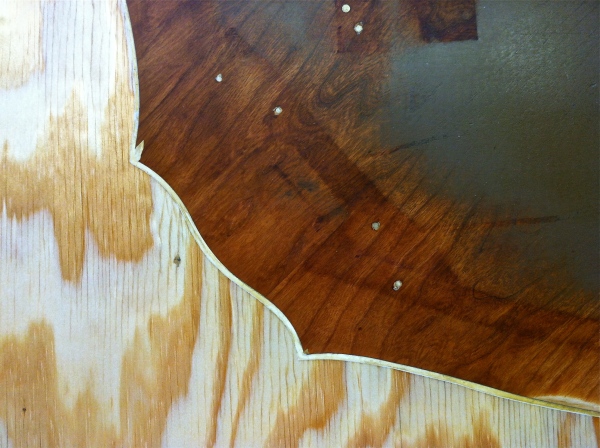
Richard Hunt, Model for Tower of Aspiration, N'Namdi Gallery

Richard Hunt, Model for Tower of Aspiration, N'Namdi Gallery

Richard Hunt’s terrific sculpture show at David Weinberg Gallery closed last weekend, but if you missed it there’s another powerful selection of Hunt’s work from the past 20 years on view at G.R. N’Namdi Gallery.

David Weinberg’s space, the smaller of the two galleries, showed off the many paradoxical elements of Hunt’s sculptures in a surprisingly effective manner. When I first walked in to that exhibition, the room felt overly crowded to the extent that I feared one of sculptures’ edges might actually jab me (or I it). But it quickly became clear that, physically at least, there was plenty of room for all of us.

Richard Hunt, Low Flight, welded stainless steel. David Weinberg Gallery

Richard Hunt, Low Flight, welded stainless steel. David Weinberg Gallery

Hunt’s work is full of surprises like that. Eluding easy formal classifications, his sculptures can’t adequately be described as organic, nor are they exactly technological in nature. They’re somewhere in between the two, where spiraling forms evoke the flow of waves or the whir of circular blades. One sculpture at N’Namdi recalls a stack of bones, human and otherwise; others have sharp, protruding hooks.  The lines of Hunt’s sculptures alternate between curving and jagged, their movement sometimes vertical, sometimes lateral, but always, always upwards.

picture-121

Stacks of things frequently rest atop stacks of other things, as if someone were trying to build a stairway to heaven by piling object upon object as high as the whole thing will go–an implausible and impossibly graceful agglomeration of broken wings, torn dorsal fins, discarded hand tools and shards of bone.

picture-6

Hunt’s sculptures may reach upwards, but they’re far from dreamy. The often rapid transitions from one form to another doesn’t suggest rebirth or regeneration so much as an effort to fit together, sometimes clumsily, that which already exists. In this Hunt’s forms evoke the forward movement of history (be it an individual’s or a nation’s) as something precariously and pragmatically achieved, in fits and starts, over time.

Richard Hunt, Incline with Rising Curve. David Weinberg Gallery

Richard Hunt, Incline with Rising Curve. David Weinberg Gallery

The show is at G.R. N’Namdi Gallery (110 N. Peoria, Chicago, 312-563-9240) through June 30th. 


Dubai’s “Storyteller” is a Big Idea, a Colossal One Might Say

May 10, 2009 · Print This Article

Dubai Storyteller SkylineDubai’s new idea is a massive sculpture called “Al Hakawati” The Storyteller. This towering figure will be a home of stories; a children’s library in its base and various spaces for performance and reading inside of the statue. Not only will it house stories but will also tell stories.

Yes, Al Hakawati will have both articulate arms and head. While it moves the arms and head it will broadcast via small speakers located throughout the park the tales it tells.

The head of the statue will house a golden room that overlooks the city and whose purpose is currently unknown but speculation is that it will be a discotheque.

Dubai Storyteller FeetRead more at visiondivision


Automata, The Art of a Moment Relived.

May 5, 2009 · Print This Article

jonhaddockdonttasemebroFrom the “Don’t Tase me Bro” incident to the Raping and murder of Abeer Qassim al-Janabi by Pte. Green, Automata can capture a moment unlike anything else. Jon Haddock’s work does that better then anything i have seen in a long while.


Brian Dettmer at Packer Schopf

April 10, 2009 · Print This Article

Brian Dettmer at Packer Schopf

Brian Dettmer’s sculptures are like steampunk versions of data clouds. Treating books as if they were bodies under investigation (the word ‘autopsy’ comes up frequently in discussions of this artist’s work), Dettmer expertly fillets them, foregrounding certain pictures, words, and illustrations while excising others in order to highlight previously unnoticed relationships. The results are densely layered bibliophilic wunderkammer that are truly incredible to behold.

Dettmer’s cuts are surgically precise, but they’re also curatorial in nature. By transforming books into objects of pure contemplation and display, Dettmer destroys their ability to be useful in the manner they once were. At the same time, he invests them with new signifying potential. In this case, bodies of knowledge are made to display their own viscera in a simultaneous rather than sequential manner; it’s not exactly like how we experience the Internet, but it certainly evokes it.

Brian Dettmer at Packer Schopf

Dettmer’s books can be  surprisingly provocative, too, stirring up all kinds of nostalgia, reverence, and even guilt about the fate of printed matter in the age of the iPhone, the Kindle, and the Vook. In the catalogue essay, portions of which have been excerpted in the gallery’s press release, Antonia Pocock argues that Dettmer’s book carvings “represent an impulse to resuscitate the tangible records of information that appear dead when faced with the dynamic, instantly adaptable media of the information era. Under Dettmer’s hand, the rigid rectangle of the book dissolves into a chaos of new data connections.”

Dettmer focus isn’t solely on text, however. It’s equally enamored of illustration, which in Dettmer’s preferred choice of books–mostly of the encyclopedic or instructional kind–take the form of intricate woodcuts, line drawings, and schematics along with various forms of cartography. The Web is filled with images, but it’s not an illustrator’s medium. The three dimensionality of Dettmer’s sculpturalized books reminds us of how the internet and the computer screen tend to flatten images, obliterating shadow and fine detail and making hand-drawn efforts largely irrelevant.

Brian Dettmer at Packer Schopf

The exhibition also includes a two-channel video downstairs which provides insight into Dettmer’s painstaking working process. Thankfully, the videos leave a lot of the how-to’s unanswered, which keeps the mystery of it all alive. I didn’t want Dettmer’s process to be totally transparent –where’s the fun in that? Instead, they remain, for me at least, Carrollian follies so strange and alluring I wanted to shrink myself down, crawl inside them, and explore.

Brian Dettmer’s “Adaptations” will be on view at Packer Schopf Gallery through May 9th.

Brian Dettmer at Packer Schopf

Brian Dettmer at Packer Schopf


Two Will Enter But Only One Will Leave

April 8, 2009 · Print This Article

Well that’s not true, in the end both of the new Millennium Park pavilions will be deconstructed and recycled. The Burnham Plan in Chicago has announced two new pavilions that are going to be installed June 19 through October 31, 2009 in Millennium Park.

The First is by Zaha Hadid and described as:

Shell like Pavilion by Zaha Hadid

Shell like Pavilion by Zaha Hadid

“A tent-like structure made of light weight aluminum and dressed in a tensile fabric. The exterior skin rises and falls along its aluminum ribs—the lines for which were derived from the diagonal lines and avenues in Burnham and Bennett’s 1909 Plan. Louvers in the pavilion’s ceiling will bring an interplay of light and shadow into the space as the sun changes position during the day. Exterior lighting will highlight the pavilion at night.

The interior of the Hadid Pavilion will serve as a screen for an immersive video installation created by UIC-trained and London-based artist Thomas Gray for The Gray Circle. This film will tell the story of Chicago’s transformation, including visions for Chicago’s future by local architects.”

It then goes on to mention the sinuous discourse and usual puffery.

The Second pavilion is by UNStudio and is listed as:

Mirror like Pavilion by UNStudio

Mirror like Pavilion by UNStudio

“Highly accessible and functions as an urban activator. Framed by Lake Michigan on one side and Michigan Avenue on the other, it relates to diverse city-contexts and scales. The edges of the roof are parallel, but toward the center there is more complexity in the form.

At night, UNStudio’s pavilion becomes a responsive architecture with LED lights that change color and pattern. These lights will be in constant flux as the number of visitors to the pavilion changes. Programmatically the pavilion invites people to gather, walk around and through the space—to explore and observe. It’s sculptural form and reactive lights will spark curiosity and wonder in its visitors.

The UNStudio pavilion is made of steel, clad in plywood, and is covered in high-gloss white paint to reflect the city and pavilion visitors.”

Now we ask you in both comment form and poll, who will survive? The winner will go one on one in a death match with a pavilion built to look like Tony Fitzpatrick.