The School of the Art Institute’s Visiting Artist Program kicks off its Spring 2011 series tonight with Jose Muñoz, chair of NYU’s Performance Studies department and the author of several books, including Cruising Utopia: The Then and There of Queer Futurity. (You can download a .pdf file of that book’s introduction here). The talk will take place at 6pm in the Columbus Auditorium, 280 S. Columbus Drive. In advance of Professor Munoz’ talk, I asked him a few questions about his work and the performance artists who inspired it. I’m very grateful to him for taking time out of his busy schedule to answer them!
*******
Claudine Ise: Tell us a bit about what you plan to discuss during your lecture at the School of the Art Institute.
Jose Muñoz: I plan to present work that bridges Cruising Utopia and my next book project The Sense of Brown. In Cruising Utopia I considered the work and life of figures from the historical queer avant-garde. I will discuss the life and work of Warhol superstar Mario Montez. Montez collaborated with Warhol, Jack Smith, Ronald Tavel and many other key figures from that scene. But Montez dropped out of the art and performance scene in the 1970s. He has recently reemerged and has great stories to tell. I look to him as a “Wise Latina” which was a phrase used by republicans who attacked Sonia Sotomayor when she was nominated to The Supreme Court. I describe Montez as a Wise Latina because she made a sort of “sense” that I think is worth considering today.

CI: The prose style of your 2009 book “Cruising Utopia: The Then and There of Queer Futurity” is at once poetic and deeply rousing. In particular, I’m enamored of this statement from your book’s Introduction:
“We must strive, in the face of the here and now’s totalizing rendering of reality, to think and feel a then and there. Some will say that all we have are the pleasures of this moment, but we must never settle for that minimal transport; we must dream and enact new and better pleasures, other ways of being in the world, and ultimately new worlds. Queerness is that thing that lets us feel that this world is not enough, that indeed something is missing.”
I love the radical openness of that idea. Can you talk a bit about the ways in which you want to re/define the concepts of ‘hope’ and ‘utopia,’ particularly when it comes to queerness and what you describe as a ‘queer aesthetic’?
JM: I was advocating an idea of hope that refuses despair during desperate times. I reject naive hope and instead offer a version of hope that is counter measure to how straight culture defines our lives and the world. I was trying to describe an idea of utopia that is not just escapism. Queer art or queer aesthetics potentially offer us blueprints and designs for other ways of living in the world. In Cruising Utopia I look at performances and visual art that are both historical and contemporary. But what all the work has in common is the way it sketches different ways of being in the world.
CI: Which contemporary performance artists do you think best represent your idea that ‘hope’ can be more than just a critical affect, but can also present us with a viable methodology for mapping utopias?
JM: I am interested in so much work that happens under the rich sign of performance. For years I have been following the work of artists like Vaginal Davis whose performances always insists on another version of reality than the ones we are bombarded by. I could substitute Vag’s name in the previous sentence with that of artists like Nao Bustamente, Carmelita Tropicana, Dynasty Handbag, My Barbarian and so many other artists that I have encountered. I look forward to seeing more work that helps me glimpse something beyond the here and now.
Dynasty Handbag at Transmodern Festival, 2008.
download

This week: Duncan talks to Professor James Elkins about the Stone Summer Theory Institute and this years theme Beyond the Aesthetic and the Anti-Aesthetic.
The Stone Summer Theory Institute is week-long school in contemporary art theory. It is held in Chicago, in July, at the School of the Art Institute.
Each year brings together an unprecedented gathering of international scholars to discuss an unresolved question in contemporary art theory. This year’s subject is the aesthetic and one of its opposites, the anti-aesthetic. Some art practices aim at aesthetic value, while other art practices aim to do something in society, in politics, or to identity. The difference between those two conceptions of art is one of the deepest unresolved questions of current art practice.
It has been announced today that Dr. Walter Massey has been named the new President of the School of the Art Institute of Chicago. This is a really hard article to write since it’s difficult to find much about Walter Massey in any kind of Art context and his business context is pretty basic as well.
Walter Massey, who currently sits on the board of McDonald’s (which is headquartered in Chicago lets remember), recently retired from the Bank of America board, president emeritus of Morehouse College in Atlanta, has worked in the Unviersity of California system and at Brown University, former board member of BP, National Commission on Smoking and Public Policy & ran Argonne National Laboratory is more like a madlibs result for the executive level of Chicago Business/General Science Education world. It’s a little of this and a lot of that.
The resume reads like a interim president who was a Chicago culture buff and said “yea, I’ll do it” when no one else would?
I know I am not the only one that realizes there is 15% unemployment (even for executives) but there is no one else eligible for this position? Someone who is a tad more focused in areas of use to the SAIC? Someone other then a 72+ year old scientist whose college administration background is “leading” his Alma mater (the self described “only all male historically black institution of higher learning in the United States”) for 12 years after he had retired from a career of Science advocacy?
How is this even close to the needs of the SAIC and Art community in the 21st century other then he is a warm body that I am sure has a Rolodex (a literal Rolodex I mean) full of moneyed contacts.
I know the Art world lives on nepotism and dresses it up as “vetting someone” but could you at least try to hide it more in the future cause it really reads poorly to a lot of people right now?
*******UPDATE********
More information has come out from, SAIC Chairman of the Board, Cary D. McMillanhas (who is also on the McDonald’s board) who by telephone from vacation in Italy told the Chicago Tribune that Walter Massey is a interim President brought on to release pressure from Elissa Tenny, who has been appointed to the newly created position of SAIC provost and senior vice president of academic affairs.
By end of the first semester, we’ll probably have a good idea of what direction we want to go, and probably begin a search some time after that. We didn’t want to be feeling that we were rushed to hire someone, and Walter is just such a great guy
Nowhere in the press release that the School issued is the term Interim even mentioned or hinted at. I am sure Dr. Massey is a great person, wonderful guy and might via his connections or mere presence help others feel more free to make the changes or growth they need but no one thought to mention that in the press release? That the Chairman needs to clarify while on vacation in Italy 7 hours ahead of Chicago for the Tribune’s late night post; the fact this in actuality an interim position?
More can be read at the Tribune’s Article here
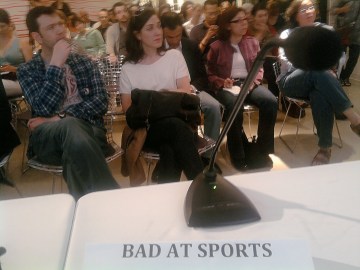
Thanks to everyone for coming out to the “Social Media Strategies in Chicago’s Art Community” panel hosted by Art Critic Alicia Eler and Chicago Gallery News’ Ginny Berg at Art Chicago today. I loved talking with Karla Loring, Museum of Contemporary Art; Crystal Pernell, Hyde Park Art Center; and Carrie Heinonen, Art Institute of Chicago about all things tech & strategy and hope that it was useful or atleast entertaining for those of you in attendance. Every group on that dais has my upmost respect for the work they do in the Arts day in and out and it is an honor to have Bad at Sports counted among them.
As promised in the talk there is a program that is quite useful in Twitter to let you know who starts following you and more importantly who drops your account. At the time I was trying to think of Chirpstats and couldn’t get the word out but the great Crystal Pernell was kind enough to remind me of Qwitter which does more then Chirpstats by working to tie the drop to a specific tweet. This can be extremely useful if at times a bit misleading but a great alternative to Chirpstats which is only a weekly update but less taxing on an email account.
The net is a wonderful place to meet, share, promote and wallow in all the things you love or cherish and social media for me is a great tool to help accomplish & magnify those desires. I still say though the most important thing is to service the end users like they are your boss, anything less is putting the cart before the horse. Feed them data, facts, images & yes even sugar and rumors some days but remember that twitter, facebook, digg, stumbleupon, and whatever is next are only a means to that end. It’s something that even we have to be vigilant to keep in perspective and doesn’t come easy for anyone especially when you have to answer to a comittee; I have deep sympathy there. I look forward to the next time we can get everyone together and have honest and open talks about how we go about trying to promote and grow this thing we love called Art.
Thanks again for coming out!
Saya Woolfalk Lectures Tuesday at SAIC
February 1, 2010 · Print This Article

Saya Woolfalk
The School of the Art Institute kicks off its current Visiting Artists Program with a lecture by Saya Woolfalk tomorrow, Tuesday February 2nd, at 6:00pm. From the Visiting Artist’s Program website:
SAIC alumna Saya Woolfalk (MFA 2004) will present her ongoing project No Place, a multimedia, fictional future that reworks tropes of sexual, racial, and gender difference. The characters and stories in Woolfalk’s constructed reality evoke travel narratives, science fiction, and the rhetoric of anthropology to investigate human possibilities (and impossibilities). Through diverse forms of installation, video, painting, drawing, performance, and sound, she reflects on human life and its future through configurations of biology, sociality, and the environment. Woolfalk’s selected exhibitions include PS1/MoMA; Museum of Contemporary Art, Chicago; Indianapolis Museum of Contemporary Art; Studio Museum in Harlem; and Momenta Art. She has been an artist in residence at Skowhegan, Yaddo, Sculpture Space, and the Studio Museum in Harlem. Presented in collaboration with SAIC Alumni Relations.
Want to bone up on Woolfalk’s work prior to the lecture? Here are some links to get you started:
Interview with Saya Woolfalk on Art21 Blog
Saya Woolfalk Artist’s Page at Zg Gallery, Chicago
Saya Woolfalk Performs No Place: A Ritual of the Empathic at Performa 09

Woolfalk’s lecture will be held at the SAIC Columbus Auditorium, 280 S. Columbus Drive.

Saya Woolfalk, The Lighthouse.
This round of VAP lectures is especially strong. Don’t forget to mark your calendars for these upcoming SAIC Visiting Artist Program lectures (click here for further details):
Doug Aitken, Monday, February 22nd, 6pm
Amy Franceschini, Thursday, March 11, 6pm
Doris Salcedo, Monday, March 15, 6pm
Matt Keegan, Tuesday, April 6, 6pm
Ryan Trecartin, Wednesday, April 14 and Thursday, April 15 at 6pm